Dark Patterns: 60% Off a Price Nobody Ever Paid
Dark Patterns is a weekly series. Each week I take one design trick that's built to get you to buy, sign up or stay, show you a real one, and show you how to spot it yourself. The sources are Trust Report Canada's public wiki, so you can check every claim.
It's Black Friday, so let's start with a Black Friday sale.
Get Featured Today sells "a published feature for $39". You write a short brief, they write an article about your business, and it runs in a "top-tier publication". This week its home page has a bright yellow banner scrolling across the top: Black Friday Special: Save 60%. Under the headline, $99 is struck through and replaced with $39. Beside that: "54 people joined today!"
That one screen holds three dark patterns. The rest of the page holds a few more. Let's take them apart.
Pattern 1: a discount from a fake "was" price
A discount is only a discount if the higher price was real. So I went to the Internet Archive and pulled every distinct copy it has of getfeaturedtoday.io: 19 of them, from March 2025 to October 2026.
- March to September 2025: $49. "This opportunity won't last" before they return to their "standard rate" of $999, later $499.
- October 2025 to April 2026: still $49, now with $99 struck through above it. "PRICE DOUBLES SOON!" A free bonus that "Expires Midnight". By March, a countdown clock.
- October 2026: new design, $39, $99 struck through.
- This week: the same $39, now a "Black Friday Special".
Not one copy sells it at $99. Not one sells it at $499 or $999 either. Their own terms, last updated May 2025, still say "the current rate for our service is $49". The price was always about to double for six months, and it never did. Then it dropped, and the drop got called a sale.
In Canada that "was" price has a name. The Competition Act calls it the ordinary selling price, and a saving measured from a price nobody actually paid is a misleading representation. The FTC's guides against deceptive pricing say the same thing in American.
How to spot it: paste the URL into the Wayback Machine and look at last month, last quarter, last year. If the "regular" price never shows up, it isn't regular.
Pattern 2: the counter that doesn't count
"54 people joined today!" has a little pulsing green dot next to it, like a live feed.
It's not live. The site is pre-built and served from a cache; when I loaded it on November 27 the copy I got had been built about 37 hours earlier. The 54 is typed into the HTML as plain text. No script on the page ever changes it. It said 54 in the Internet Archive's copy from October 26. It said 54 when Trust Report captured it the same day, on November 26 and on November 27. The page I captured on the 27th was byte-for-byte the same file as the one from the 26th.
Fifty-four people join every single day, apparently. It's a very consistent business.
That's manufactured social proof: a number dressed up as a measurement so you feel like you're late to something.
How to spot it: come back tomorrow. Better, view the page source (Ctrl+U) and search for the number. If it's sitting there as a literal, nobody is counting anything.
Pattern 3: ten buyers on a loop
Get Featured Today also runs a quiz at quiz.getfeaturedtoday.io. While you click through it, little cards pop up in the corner:
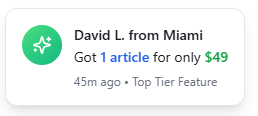
Real-time purchase notifications are a whole product category. Some of them are even real. This one isn't, and you don't have to take my word for it, because the whole list ships in the page's JavaScript. Trimmed:
yf=[{name:"Amelia U.",location:"Boston",articles:1,price:49,package:"Top Tier Feature",minutesAgo:2},
    {name:"James K.",location:"Austin",...,minutesAgo:15},
    {name:"Sarah M.",location:"Seattle",...,minutesAgo:28},
    {name:"David L.",location:"Miami",...,minutesAgo:45},
    ... six more, ending with ...
    {name:"Ryan H.",location:"Phoenix",...,minutesAgo:178}]
Ten names, ten cities, ten fixed "minutes ago". A timer shows one for five seconds, hides it for two, moves to the next, and starts over after Ryan. There's no request to a server for recent orders. David L. bought his article 45 minutes ago on every visit, forever. And every one of them paid $49, on a quiz that funnels you to a $39 checkout. Even the fake buyers didn't get the Black Friday price.
While I was in there: the progress bar says "Step 1 of 6". There are four screens. Whatever you answer, the last one congratulates you on unlocking "exclusive bonuses" and sends you to the same checkout. Your answers never leave the page. It's a personality quiz where every personality is "customer".
How to spot it: watch the pop-ups for a minute. If the same names come back in the same order, it's a slideshow. On desktop, the browser's developer tools (F12, Network tab) will show you whether anything is actually being fetched.
Pattern 4: testimonials you can't check
"What clients say: 4.9 Excellent · Based on 300+ verified reviews." Verified by whom? Doesn't say. You can't click it. In 2025 the same spot said "Excellent 383 reviews", so the review count has gone down since. The stars sit in little green squares, coloured #00b67a in the page's CSS. That's Trustpilot's green, and "Excellent" is the word Trustpilot prints beside a high TrustScore. The badge never says Trustpilot. It doesn't have to: it just has to look like it.
The one review platform with a Get Featured Today profile is Trustpilot. The company claimed that profile in April 2025. On November 27 it had 26 reviews and a TrustScore of 3.1, with 31% of them one star. Trustpilot calls a 3.1 "Average".
The first testimonial on the page, on every archived copy going back to March 2025, is "Dr. Peter Smith MD, Queensland Allergy Services": featured "in less than a week" in USA Today, LA Times, Forbes and more. No link, no date, no platform. Trust Report Canada has a page on Professor Peter Smith. Companies House filings list a Professor Peter Smith as a creditor of two of the founder's UK companies, and the founder lists Professor Smith's skincare brand as one of his own investments. Trust Report's conclusion from the record is that they're the same man. Hold that thought, because he comes back in pattern 6.
A testimonial from someone with a business relationship to the seller, and no word of it on the page, is an undisclosed material connection. The FTC's endorsement rules require that to be disclosed. So does Canada's Competition Bureau.
How to spot it: a testimonial that doesn't link to a review on a platform you can search isn't evidence. It's copy.
Pattern 5: the scary chart
Halfway down the page there's a comparison table, "The old way, and the new way". The old way: "PR agency retainers of $3,000 to $10,000 a month", "Three to six months of pitching before anything lands". The new way: "$39, once" and "Days".
I expected those numbers to be invented. Honestly, they're not far off. Published surveys put boutique PR retainers in roughly that range, and big firms well above it. The trick isn't the numbers. It's the comparison.
A PR retainer pays someone to pitch your story to editors who don't work for you and are free to say no. When they say yes, that's coverage: a journalist decided you were worth writing about. What Get Featured Today sells is placement, and those aren't the same product at a different price. They're different products.
If you want to know what placement really costs, compare it with placement. EIN Presswire charges $149 to distribute one press release, and says every package reaches AP News and the USA TODAY Network's sites. USA Today's own ad arm sells branded content on its network. Both are clearly sold as what they are.
And the part the chart leaves out entirely: if your story is actually news, it costs nothing. Reporters need stories. A local paper, a trade publication, a beat reporter who covers your industry: they cover things because they're interesting, and pitching them is free. The $3,000 to $10,000 is for people who'd rather pay someone to do that pitching. The $39 is for skipping the part where anyone has to decide your story is worth telling.
Pattern 6: "Real articles we published for clients"
This is my favourite part of the page. Three phone screenshots, captioned:
- Client article on USA Today
- Client article on Forbes
- Client article on Insider
Here's what's actually in them.
"USA Today" is a Woman's Week article: "Peora Jewelry: Redefining Luxury with American-Made Craftsmanship", by "Woman's Week Contributor". Not USA Today. Woman's Week is one of Get Featured Today's own five "guaranteed" outlets, and its parent company says it established the site. The Internet Archive's copies of that article end with a line the screenshot doesn't reach: "This article features branded content from a third party." The article was live in July. On November 27 it was a 404, and searching Woman's Week for "Peora" finds nothing. The home page promises "a permanent link". Their terms, section 6.3: "we cannot guarantee that articles will remain published indefinitely."
"Forbes" really is Forbes: "The 4+4 Blueprint: Inside The Hofstra BS/MD Experience", by Kristen Moon, who runs an admissions counselling company and was a Forbes contributor at the time. It's an explainer about a university's medical program. It doesn't promote a client. Its only outside link goes to Hofstra. Her Forbes byline now reads "Former Contributor". There's nothing on the page connecting her to Get Featured Today. Why it's on their home page as a client article, I can't tell you.
"Insider" is USA Today. "Professor Peter Smith: Decades of Research Bridge Science and Skincare Innovation". Yes, him again, the testimonial guy. The article sits in USA Today's "Contributor Content" section, and right under the photo it says: "Members of the editorial and news staff of the USA TODAY Network were not involved in the creation of this content." Here's the thing: that line is in Get Featured Today's own screenshot. But the home page displays the image in a frame that crops off the bottom third, so the notice and the byline are exactly what you don't see.

So, of three proof-of-work samples: two are captioned with the wrong outlet, one was deleted, one doesn't feature a client, and one is cropped right above the line telling you it isn't journalism. Trust Report has the full breakdown.
How do you even become a "contributor"?
Since both of the big-name samples are contributor content, it's worth knowing what that means.
- Forbes contributors are outside writers, not staff. Each article says "Forbes contributors publish independent expert analyses and insights." You get in by applying or being introduced to an editor. There's also Forbes Councils, a paid membership for business owners above a revenue threshold, whose members publish on Forbes.com with Forbes' publishing team.
- USA Today Contributor Content is a separate section of usatoday.com, with its own hub and the notice that the newsroom wasn't involved. A whole cottage industry sells "guaranteed" placement there.
None of that is secret, and none of it is illegal on its own. Contributor programs and sponsored content are fine when they're labelled. The labels are the point. What makes it a dark pattern is taking the label off, or cropping it out, before you show it to a customer as proof.
What you actually get for $39
The "What you get" list, held up against Get Featured Today's own terms:
- "Publication you choose." Section 2: placement is guaranteed only in five outlets, Digital Journal, Insider Weekly (not Insider), New York Telegraph, Tampa Bay Observer and Woman's Week. At least two of those belong to the same parent company. Forbes, USA Today, AP, NBC and Fox News, the logos on the home page, are "non-guaranteed": they'll "pitch your story to our contacts".
- "In 24 hours. Guaranteed." Section 6.1: they "strive" for one to three days, and "cannot guarantee specific publication dates or times". The quiz says seven days.
- "A permanent link." Section 6.3, quoted above. Ask Peora.
- "We publish it and send you the live link." For the outlets that matter, they don't publish anything. USA Today's notice says its newsroom wasn't involved; the most a reseller can do is buy a slot in a contributor section.
- "Will the article be marked as sponsored?" is a question in their own FAQ. Section 8.5 has you agree the articles run "without sponsored or promotional tags". Their own Woman's Week and USA Today samples both carry a disclosure. Good. The disclosure is the one part of this that's working as intended.
The guarantee
"Our 'Get Featured' Guarantee: If, for any reason, we are unable to get your business featured you will receive a full refund, no questions asked."
Section 4.2 of the terms: no refund once you've submitted the intake form, "as this represents commencement of our services". No refund for non-guaranteed outlets. Section 3.3: no refund "based on publication selection outcomes". You find out which outlets are guaranteed in the intake form, after you've paid. The checkout itself doesn't show you the terms.
What the Trustpilot reviewers describe matches the terms, not the banner. Reviewers' own words, not verified by me: one picked USA Today and got two sites "no one has ever heard of"; one says that after paying they were shown which outlets were actually guaranteed; one bought in January and, after about ten emails, had "No article, No REFUND"; one says they were offered a USA Today article if they'd remove their negative rating.
That last one has a name too: review gating.
The checklist
Next time a sale page is talking to you:
- Check the "was" price in the Wayback Machine. If it never existed, neither does the discount.
- Come back tomorrow. Countdown still at 23:59:59? Still 54 people? It's decoration.
- Watch the pop-ups. Same names, same order, same "minutes ago" means it's a slideshow.
- Click the testimonials. If they don't go anywhere, they aren't reviews.
- Read the screenshot, not the caption. And find the original. Look for "contributor", "sponsored", "branded content" or "partner".
- Read the refund terms before you pay, not the guarantee badge.
If you bought on a promise the terms took back, you can report it: in Canada to the Competition Bureau, and in the US to the FTC. Trust Report keeps a list of where to report.
Next week: another pattern. If you've seen one that bugs you, send it to [email protected].
Research for this post: Get Featured Today's site, checkout and quiz code captured November 26 and 27, 2026; Internet Archive copies of the home page from March 28, 2025 to October 26, 2026; Archive copies of the Woman's Week, Forbes and USA Today articles; Trustpilot, November 27, 2026. The full record is on Trust Report Canada's wiki, and their plain-language version, with the five checks, is What you need to know about Black Friday "was" prices. Amira at Trust Report ran the first pass on the quiz and the price history.